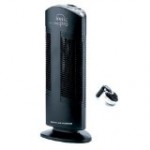
 The product: Dust, cigarette smoke, pollen and pet dander: With so many irritants floating around our homes and work places, clean air is a hot commodity. Americans spend hundreds of millions of dollars on furnace filters and air cleaners each year.
Though some consumers are simply trying to bring a little extra freshness into their lives, many others hope that their investment will help relieve their asthma or allergies.
If you've ever shopped for an air cleaner -- or if you've ever idly flipped through a SkyMall catalog -- you've undoubtedly seen ads for ionic air purifiers, devices that take an unusual approach to clearing the air. Instead of relying on fans to move air through filters, the machines release a steady stream of negatively charged ions that electrify the bits of dust, dander or other flotsam.
The airborne particles pick up the negative charge and become strongly attracted to positively charged collection plates inside the machine. (In many cases, they also become attracted to other charged surfaces such as walls, table tops and TV screens.)
Except for a few models that use fans to help suck in the charged particles, most ionic air purifiers work silently. And, as ads are quick to point out, the devices generally don't have any motors or moving parts, and there are no filters to replace.
There's another thing that separates ionic air purifiers from other technologies: To varying degrees, all ionic air purifiers release ozone, a potential pollutant. A 2006 study by researchers at UC Davis found that one popular brand, the Ionic Breeze Quadra, released about 2.2 milligrams of ozone per hour, or about as much as a constantly running photocopier.
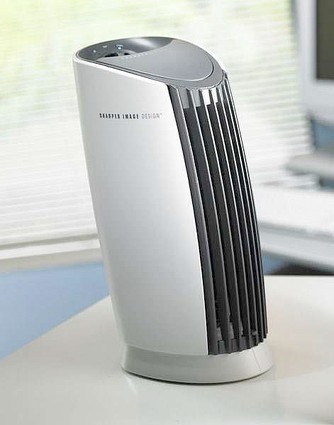
courtesy of sharperimages.com
(Ionic purifiers shouldn't be confused with ozone generators that are marketed as "air cleaners." By design, these devices can release 50 to 200 milligrams of ozone per hour.)
Ionic purifiers are sold at drugstores, at department stores and via the Internet. The well-known and heavily advertised Ionic Breeze line is one of the cornerstone products of the Sharper Image, the high-end gadget store. One current offering, the Ionic Breeze GP, stands more than 2 feet tall and as an added feature comes equipped with a UV light to help kill airborne germs. If you buy one for $400, the second costs $200.
The Sharper Image also sells a 13-inch unit for $150. You can buy a 28-inch Ionic Pro Turbo Air Purifier from Wal-Mart for $180. An online company called Heaven Fresh sells the table-top XJ-2000 ionic air purifier for about $50.
The claims: According to the Sharper Image website, the Ionic Breeze is "proven effective at reducing airborne allergens and irritants -- with no fan, no motor and no noise."
The Heaven Fresh website says that its purifiers can provide relief from "asthma, bronchitis, hay fever and other respiratory diseases." Heaven Fresh also claims that the ozone emitted by its machines helps clean the air. According to the site, "ozone is one of the purest and most powerful oxidants and germicides known."
The bottom line: Ionic air purifiers have undeniable appeal, but there's a problem: They don't really improve air quality, says Dr. James Sublett, a clinical professor at the University of Louisville; a fellow at the American College of Allergy, Asthma & Immunology; and co-chair of the 2007 ACAAI Healthy Indoor Environment conference. "We [allergists and immunologists] generally don't recommend them," he says. "This is a windmill that I've been tilting at for a number of years."
According to Sublett, the devices don't effectively remove dust, dander and other irritants from a room. Without fans, he explains, they can't collect airborne particles from more than a few feet away. And when even small amounts of dust enter the device, the plates inside quickly lose much of their power to attract more particles. Meanwhile, the charged particles that stick to walls or TV screens haven't left the room and can always billow up again to cause trouble.
The ozone released from the devices is another deal-breaking shortcoming, Sublett says. "Ozone is a pollutant and an irritant. Even small amounts are too much." People who use several units at a time are especially likely to get an ozone overload, he says. One of Sublett's patients noticed a great improvement in her breathing when she turned off the six ionic purifiers in her home.
The California Air Resources Board recently banned all devices that create an ozone concentration of more than 50 parts per billion, starting in 2009. Under normal conditions, ionic purifiers (as opposed to ozone generators) would fall below that threshold, says Jeffery Siegel, an assistant professor of civil, architectural and environmental engineering at the University of Texas at Austin who has studied the devices in laboratories as well as his own bedroom. Still, he says, the new standard is misleading because even products that release small amounts of ozone could easily reach that concentration in small, poorly ventilated spaces.
Sublett says people with asthma or allergies should consider installing high-efficiency particulate air (HEPA) filters in their heating or cooling systems. The ultra-fine mesh on these filters traps all sorts of irritants that would otherwise circulate through the home.
Written by: Chris Woolston
|
Babyliss Pro BABNT5548 2000 Watt Ionic Nano Titanium with Integrated Ion Generator Hair Dryer List Price:  |
|
|
Nano Titanium- is an exceptional conductor of heat, maintains stability in ultra-high temperature. Nano Titanium emits negative ions that eliminate frizz and close the cuticle to create smooth, shiny hair...
|
|
BaByliss Pro BABP2800 Porcelain Ceramic 2000-Watt Dryer, Black List Price: |
|
|
BaByliss PRO Super Turbo Professional Commercial Grade Porcelain Ceramic 2000 Watt Hair Dryer with ionic technology emits negative ions eliminate static, reduces drying time. Ceramic generates far infrared heat to protect hair's luster.
|
|
BaByliss Pro TT Tourmaline 3000 Natural Ionic Hair Dryer 1 ea List Price: |
|
|
Variable Heat and Speed Settings.
|
|
Molten Salts and Ionic Liquids: Never the Twain List Price: |
|
|
For many years, the related fields of molten salts and ionic liquids have drifted apart, to their mutual detriment. Both molten salts and ionic liquids are liquid salts containing only ions - all that is different is the temperature! Both fields involve the study of Coulombic fluids for academic and industrial purposes; both employ the same principles; both require skilled practitioners; both speak the same language; all then that is truly different is their semantics, and how superficial is that?The editors of this book, recognising that there was so much knowledge, both empirical and theoretical, which can be passed from the molten salt community to the ionic liquid community, and vice versa, organised a landmark meeting in Tunisia, designed to bridge the gap and heal the rift...
|
|
The Universal Sense: How Hearing Shapes the Mind List Price: |
|
|
The surprising truth about how the things our ears hear affect what's between them. Every day, we are surrounded by millions of sounds - ambient ones like the rumble of the train and the hum of air conditioner, as well as more attention-grabbing sounds, such as human speech, music, and sirens...
|
Posted by Irwan on December 14, 2009


I agree with what you’re saying - ionic purifiers have a lot of shortcomings and don’t filter the air well. However, I do believe that any air purifier is better than none at all, and that as people get exposed to them they will eventually opt for a better machine.
Also, ozone is a very effective air cleaner - its just a little too stable to be used indoors.