Reog Ponorogo
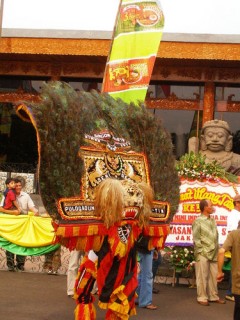
Reog Ponorogo is a traditional dance of Java tribe that a one tribe in Indonesia. Reog Ponorogo is a dance art with a main character of the dancer is using a mask likes a Chinese Barongsay. The different is in the Reog mask used is a big tiger masking with a decoration of peacock feathers.

(lingga17.wordpress.com)
There are some version of popular story in the society about the origin of Reog and Warlock. Below is one of the versions.
Reog Ponorogo Story
According to a story, the borne of Reog Ponorogo art is on the year of 900 Saka, with a background of a story about the journey Prabu (Price) Kelana Sewandana, a king of Bantarangin that looking for a wife to be his queen. Together with his loyal obedient named Bujangganong, and his horse soldiers. Finally he found his ideal lady, a Kediri lady named Dewi Sanggalangit.
But the lady asking for a condition that the Prabu that firstly must creating a new art before she accept with the king love. From that the Reog dance began. Reog is also a satire with the meaning that the King (head of a tiger) is controlled by the Queen (peacock).
Normally in one group of Reog performance consists of one old Warok, several young Warok, the dancer with a mask or pembarong, Bujang Ganong dancer, and Prabu Kelono Suwandono. Totally about 20 to 30 dancers, and central of role is at the hand of Warok and the pembarong.
The wording of Reog originally is Reyog, that every character representing the first character of words of song of Macapat Pocung; Rasa kidung/Engwang sukma adiluhung/Yang Widhi/Olah kridaning Gusti/Gelar gulung kersaning Kang Maha Kuasa.
The flow of story of Reog Ponorogo performing is Warok, and then Jatilan, Bujangganong, Kelana Sewandana, and then Barongan or Dadak Merak at the end. When one of that part is happen, another parts are also following dance, even it is not dominant. The dance itself has a several combination with two or three opening dance.
The modern Reog Ponorogo normally performing at some occasion, likes a wedding ceremony, national days, or even circumcision ceremony.
 The first dance of Reog Ponorogo performing by six or eight man in the black dress, with the face make up by red color. Reog Ponorogo dancer illustrated as a brave Lion. The next is a dance performing by six or eight woman by riding a horse.
On the traditional Reog Ponorogo, the dancers usually a man that using a woman dress. This dance called as Jaran Kepang dance, this dance is different with the other traditional dance called Kuda Lumping dance. The other opening dance, if any, is a dance performing by a kid as a funny dance.
After the opening dance is finish, that is performing the main story that the story will depend on the condition of the event of that Reog performing for. If performing for a wedding ceremony the story is about the love. If performing for circumcision ceremony, the story is about a heroism.
Normally there is no well arrangement scenario on the Reog Ponorogo performance. There is always an interaction between the dancer and the Dalang (leader of the group) and sometimes with the audience.
Sometimes one dancer on performing at the stages suddenly changes by others, if he tired. The important thing in the Reog performance is to give satisfactory to the audience.
The last scene is Singa Barong, where the dancer used a mask of lion head with a crown made by peacock feather. The weight of mask itself is around 50-60 kg. This heavy mask bring by the dancer by using his teeth. This happen through a routine hard practice, Reog Ponorogo also believes by doing a spiritual practice asceticism and fasting.
Links:
Reog Ponorogo Related Books
|
Erotic Triangles: Sundanese Dance and Masculinity in West Java (Chicago Studies in Ethnomusicology) List Price: Sale Price: $17.24  |
|
|
In West Java, Indonesia, all it takes is a woman’s voice and a drum beat to make a man get up and dance. Every day, men there—be they students, pedicab drivers, civil servants, or businessmen—breach ordinary standards of decorum and succumb to the rhythm at village ceremonies, weddings, political rallies, and nightclubs... |
|
Music in Central Java: Experiencing Music, Expressing Culture Includes CD (Global Music) List Price: Sale Price: $23.63 |
|
|
Music in Central Java is one of several case-study volumes that can be used along with Thinking Musically, the core book in the Global Music Series. Thinking Musically incorporates music from many diverse cultures and establishes the framework for exploring the practice of music around the world... |
|
Jaranan: The Horse Dance and Trance in East Java (Verhandelingen) Sale Price: $55.60 |
|
|
The dramatic genre of the horse dance (jaranan) is part of an age-old Javanese tradition displaying wide local and regional variations. A striking feature of the performances of the majority of horse dance groups is the appearance of trance dancers... |
|
The Bedhaya Court Dances of Central Java (Asian Studies) Sale Price: $356.04 |
|
|
The ritual bedhaya dances of the Central Javanese courts form a highly valued expression of Javanese culture. These stately dance forms, comprising complex choreographies executed to the accompaniment of archaic songs and gamelan music, are part of the cultural tradition of the Mataram dynasty... |
|
Gamelan: Cultural Interaction and Musical Development in Central Java (Chicago Studies in Ethnomusicology) List Price: Sale Price: $25.99 |
|
|
Gamelan is the first study of the music of Java and the development of the gamelan to take into account extensive historical sources and contemporary cultural theory and criticism. An ensemble dominated by bronze percussion instruments that dates back to the twelfth century in Java, the gamelan as a musical organization and a genre of performance reflects a cultural heritage that is the product of centuries of interaction between Hindu, Islamic, European, Chinese, and Malay cultural forces... |
Posted by Irwan on November 3, 2009

