Anatomy Skeleton as a Framework
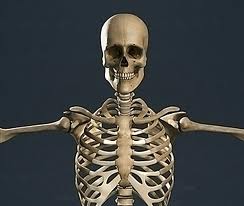
The strong inner framework of the body is formed by anatomy skeleton. Made up of separate bones that are linked together at joints, the skeletal system not only gives the body its shape, but also provides anchorage for the muscles that move it.
It supports and protects vital organs, such as the brain, heart, and lungs. Although bones themselves are rigid, they are linked by joints that give the skeleton a great deal of flexibility.
Before birth, the skeleton is made mostly of cartilage, and as result is less rigid. As the body grows, cartilage is gradually replaced by bone, though some remains in the joints and also in the nose and ears.

Anatomy skeleton is made up of 206 separate bones, which differ in shape, size, and name. The skull, backbone, ribs, and sternum are from the central part of anatomy skeleton. The bones of the arms and legs hang symmetrically on either side, attached respectively by the pectoral girdle (clavicle and scapula) and the pelvic girdle.
Bones are not dry and lifeless, as may be thought, but are active organs containing living cells surrounded by protein fibers and mineral crystals. They act as mineral stores and are constantly exchanging calcium with blood. Inside anatomy skeleton, some bones, marrow produces red and white blood cells.
 In anatomy skeleton, there is highly magnified image shows a mature bone cell called an osteocyte. It lies within a fluid-filled space called a lacuna, which is surrounded by compact bone. The cell has a large oval nucleus, which is visible in the lower part of the cell.
Osteocytes send thin branches of other osteocytes. Their role is to maintain bone, exchanging nutrients and waste with the blood. Other types of bone cell, called osteoblasts and osteocyte make bone and break it down.
Anatomy skeleton describe the link of joints. Joints are the parts of the skeleton where two or more bones meet.
Held in place by strong bands of tissue called ligaments, they allow the bones to move and give the skeleton its flexibility. Each joint has its own range of movements, though most, like the knees, can move freely. In order to reduce friction, the ends of the bones at joins are covered with smooth cartilage.
Anatomy skeleton could be learned with radionuclide or gamma scan. It could scan the whole anatomy skeleton in a living person. It is produced in hospitals or clinics with special scanning equipment.
It is also very useful in medicine because the scan helps doctors discover whether the bones are diseased. Doctors also use other test, such as X-rays, MRI, and ultrasound to examine the anatomy skeleton.
Anatomy Skeleton

Posted by Irwan on February 18, 2011

