Most Misunderstood About Abdomen Anatomy
Abdomen anatomy with its J-shaped bag is tucked beneath the ribs, and although it can stretch to fill with food, it does not absorb any of the nutrients that food contains. Instead, the abdomen anatomy has two main functions: it gets digestion underway, storing any semi digested food, and then releases it at a slow and steady rate.
In the abdomen, highly acidic gastric juice allows enzymes to break down proteins, while powerful waves of muscle contraction churn the food to mix it up. After several hours of this kind of treatment, the runny result-called chyme-is ready to move on.
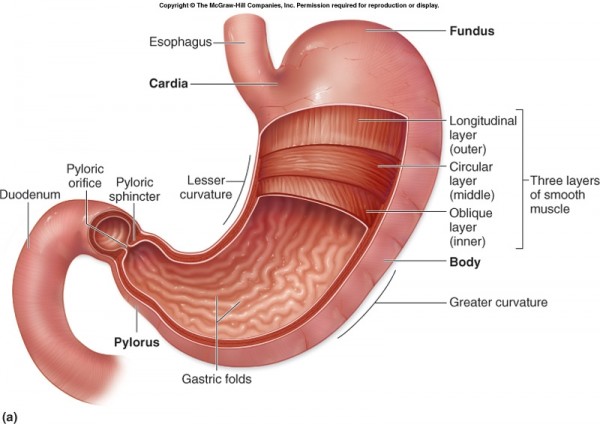
Inside Abdomen Anatomy
Inside the abdomen anatomy, it is the widest and most elastic part of the alimentary canal. When it is empty, it can be smaller than a fist, but its volume can increase by more than 20 times after a meal, because the rugae (deep folds) of its inner surface become smoother as it fills.
Unlike the rest of the alimentary canal, the abdomen’s lining has three layers of smooth muscle, arranged at angles to each other. By contracting in turn, these muscles churn up the food. At the base of the abdomen anatomy, a ring of muscle called the pyloric sphincter acts like a valve, controlling the release of semi-digested food.
Cells in the abdomen’s millions of gastric glands produce the components of gastric juice-mucus, hydrochloric acid, and pepsinogen, a substance that is converted into protein-digesting pepsin as it flows into the abdomen.
The abdomen does not digest itself because its lining is covered with protective mucus, and because pepsin becomes active only when it has been “primed” by acid.
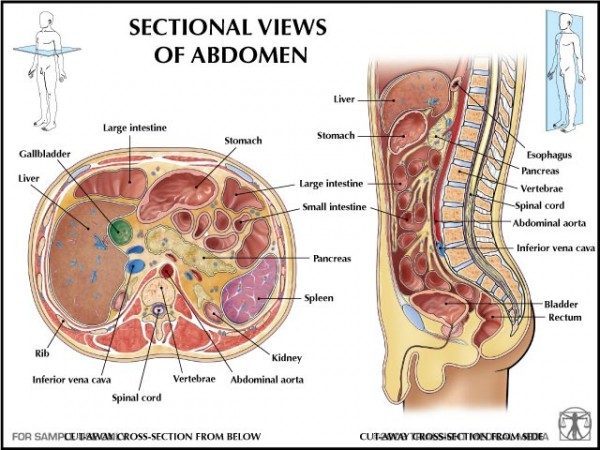
By the time food reaches the abdomen, the abdomen is ready to receive it because it has been primed by the autonomic nervous system. During its stay here-which can last for up to four hours-nerves and hormones work together to keep the digestive process working smoothly.
These two control systems ensure that the abdomen secretes enough gastric juice, and also trigger muscular peristaltic movements in the abdomen wall. When digestion has progressed far enough, the pyloric sphincter relaxes, and the abdomen’s contents flow into the small intestine.
Seen through an endoscope of the abdomen anatomy, the pyloric sphincter guards the entrance to the duodenum-the first part of the small intestine. When this of muscle is tightly contracted, nothing can leave the abdomen, but as digestion proceeds it begins to relax.
This relaxation is controlled by a feedback-mechanism, which ensures that semi-digested food leaves the abdomen anatomy at the right rate.
When food enters the abdomen, it is mixed with a digestive fluid called gastric juice. This juice contains hydrochloric acid, and it is strong enough to dissolve small pieces of bone. These acidic conditions are needed for protein digestion, which is carried out by an enzyme called pepsin. Abdomen configures the whole process of digestion.
Abdomen Anatomy Books
 |
Principles of Anatomy and Physiology (Tortora, Principles of Anatomy and Physiology) Sale Price: $132.00  |
|
Five Interesting Functions of the Human Body Most forms of color blindness, an inherited inability to distinguish between certain colors, result from the absence or deficiency of one of the types of cones... |
 |
Laboratory Manual for Anatomy and Physiology Sale Price: $51.90 |
|
The Laboratory Manual for Anatomy and Physiology by Allen and Harper presents material in a clear and concise way. It is very interactive and contains activities and experiments that enhance readers’ ability to both visualize anatomical structures and understand physiological topics... |
 |
Principles of Human Anatomy Sale Price: $60.29 |
|
Principles of Human Anatomy, a market-leading text through its many editions, successfully blends visual and textual elements to illuminate the complexities of human anatomy. The 12th edition raises the standard for excellence in this discipline with its enhanced illustration program, refined narrative, and the integrated design of dynamic resources like Real Anatomy into the curriculum... |
 |
Lippincott's Concise Illustrated Anatomy: Back, Upper Limb and Lower Limb List Price: Sale Price: $40.81 |
|
The first title in the new three-volume Lippincott's Concise Illustrated Anatomy series, Back, Upper Limb and Lower Limb supports medical students as well as others studying anatomy—such as students in physical therapy, occupational therapy, physician assistant, and dental programs—or seeking a specialty reference for the clerkship years and beyond... |
 |
Gray's Anatomy for Students: With STUDENT CONSULT Online Access, 2e List Price: Sale Price: $59.62 |
|
It didn't take long for students around the world to realize that anatomy texts just don't get any better than Gray's Anatomy for Students. Only in its 2nd edition, this already popular, clinically focused reference has moved far ahead of the competition and is highly recommended by anyone who uses it... |
Posted by Irwan on February 15, 2011

