Cigarette smoke contains 4000 harmful chemicals. 60 of them are carcinogens. Nicotine is the addictive element in the cigarette smoke.
The National Institute of Drug Abuse is developing the nicotine vaccine to counteract the additive effect of nicotine. This article tries to gain further insight in to the findings.
Why a Nicotine Vaccine is required badly?
- Smokers remain additive because of the influence of nicotine on brain cells.
- Quitters suffer from the withdrawal symptoms primarily because of the nicotine.
- Passive smokers are equally at risks of the dangers of smoking.
What the Nicotine Vaccine research is about ?
- Nicotine releases a hormone called dopamine.This hormone gives the feeling of relief and high to which smokers are addicted.
- It influences the same region of the brain,which other drugs also influence.
- The researchers are trying to find about the receptors in the cells of the brain that respond to nicotine during this process.
- Understanding of the mechanism which helps nicotine in influencing the brain cells is imperative.
- With this knowledge,a counter mechanism can be devised in the form of the drug or vaccine.
How the Nicotine Vaccine works ?
- Researchers are testing nicotine vaccine on humans.
- Nicotine gets absorbed in to the blood stream in 30 seconds of inhalation of the smoke.
- The components in the vaccine try to arrest this process of fast absorption of nicotine in the blood stream.
- In this way,it is stopped from reaching the brain. It is because nicotine is known to effect the organs of the body in unexpected ways once it reaches the brain.
- The nicotine vaccine also tries to decrease the rewarding effects of nicotine on the brain cells.
- The results are found to be promising.
- The researchers at The National Institute of Drug Abuse are hopeful that this nicotine vaccine will be a reality soon
NicVAX ®(Nicotine Conjugate Vaccine)
NicVAX® (Nicotine Conjugate Vaccine) is an investigational vaccine designed as an aid to smoking cessation, as well as an aid to prevent relapses of a treated smoker.
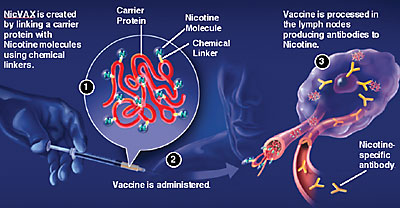
NicVAX represents an extension of our conjugate vaccine technology that allows us to address a significant medical need. We believe that broad commercialization of NicVAX will be in conjunction with a marketing partner that has a demonstrated expertise in executing large scale sales and marketing programs because the physician audience will likely be primary care physicians and focused outside the hospital setting.
Nicotine is a small molecule that upon inhalation into the body quickly passes into the bloodstream and subsequently reaches the brain by crossing the blood-brain barrier. Once in the brain, the nicotine binds to specific nicotine receptors, which results in the release of stimulants, such as dopamine, providing the smoker with a positive sensation, which causes addiction.
NicVAX is designed to stimulate the immune system to produce antibodies that bind to nicotine in the bloodstream and prevent it from crossing the blood-brain barrier and entering the brain. Therefore, the brain does not produce the positive-sensation stimulants as a response to nicotine.
Pre-clinical animal studies with NicVAX have shown that vaccination could prevent nicotine from reaching the brain blocking the effects of nicotine, including effects that can lead to addiction or can reinforce and maintain addiction.
Nicotine addiction is difficult to treat effectively. We believe NicVAX has advantages over existing treatment therapies because its effect is irreversible for potentially six to 12 months following vaccination as antibodies to nicotine continue to be produced by the body's immune system.
This is important due to the extremely high relapse rate that has been observed when a smoker attempts to quit smoking. Currently, smokers being treated for nicotine addiction can stop using their therapy and resume their addiction.
In September 2005, we were awarded a $4.1 million grant by the U.S. National Institute on Drug Abuse, or NIDA, partially offsetting our funding requirements for the NicVAX development program.
Following the award of the NIDA grant, we formed a scientific advisory panel to provide us guidance on clinical trial design and clinical development plans for NicVAX.
Market
Smoking is a global healthcare problem. The WHO estimates that there are 1.3 billion smokers worldwide today and nearly five million tobacco-related deaths each year. If current smoking patterns continue, smoking will cause some 10 million deaths each year by 2020. According to the CDC, tobacco use is the single leading preventable cause of death in the U.S., responsible for approximately 438,000 deaths each year.
In addition, it is estimated that smoking results in an annual health-related economic cost of approximately $157 billion. The CDC estimates that, among the 45 million adult smokers in the U.S., 70% want to quit, but less than five percent of those who try to quit remain smoke-free after 12 months.
Clinical Trials
In February 2006, the U.S. Food and Drug Administration granted Fast Track Status to NicVAX for use as a therapeutic for smoking cessation.
Popularity: 1% [?]
Related posts:
